

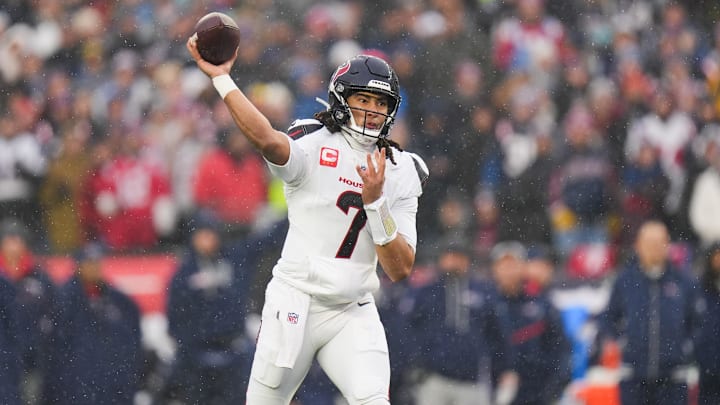
Despite injuries to several of his top receivers and one of the worst offensive lines in the NFL, C.J. Stroud - and the Texans defense - have willed Houston to the playoffs in consecutive years. Now entering his fourth season in the NFL, Stroud is extension eligible this offseason.
Stroud was a part of a fantastic first round for the Texans and general manager Nick Caserio where they landed him and defensive end Will Anderson Jr. Now the team will need to decide whether they want to lock one or both up to long-term deals.
There isn't a sense of urgency other than the fact that the salary cap continues to rise, and with it the cost of top-of-the-market players with it. And make no mistake, both Stroud and Anderson are top-of-the-market players. But Houston still has at least two years of control over both players. There seems to be an impetus from the team to get Anderson locked up first.
That makes sense given the edge market is in the midst of a boom while the quarterback market doesn't have many other candidates to push it forward at this time (although Drake Maye is just a year away from changing that math).
The Cost of A C.J. Stroud Extension
Even with modest counting stats this year - 19 touchdowns and 3,041 yards - he still takes care of the ball while displaying composure and a knack for making big time throws. Those traits buoy his value and will keep him in the upper echelons of contracts. Let's compare him to a few of his contemporaries over the three years preceding their contracts.
Player | Passing Yards | TD | INT | Big Time Throws | Turnover-worthy Plays | BTT-TWP Rate | yds/att |
|---|---|---|---|---|---|---|---|
CJ Stroud 2023-2025 | 11,158 | 63 | 26 | 62 | 50 | +0.8% | 7.5 |
Brock Purdy 2022-2024 | 9,518 | 64 | 27 | 45 | 42 | +0.3% | 8.9 |
Trevor Lawrence 2021-2023 | 11,771 | 58 | 39 | 85 | 72 | +0.7% | 6.7 |
Justin Herbert 2020-2022 | 14,089 | 94 | 35 | 82 | 42 | 1.9% | 7.2 |
Because of the rising nature of the cap, using APY as a % of salary cap in year signed acts as a better barometer, a more apples-to-apples if you will, than the APY's themselves. Here is a look at the trio of comps laid out along those terms.
Player | Year Signed | APY | Salary Cap | APY as % of Cap |
|---|---|---|---|---|
Justin Herbert | 2023 | $52.5 million | $224.8 million | 23.35% |
Trevor Lawrence | 2024 | $55.0 million | $255.4 million | 21.53% |
Brock Purdy | 2025 | $53.0 million | $279.2 million | 18.98% |
Herbert largely stands in a league of his own across those production marks, and at 23.35% of the cap in the year signed, his $52.5 million APY still stands as the high-water mark for the group. It has been reported that the league is homing in on a 2026 salary cap between $301.2 and $305.7 million dollars. I don't think Stroud's camp can make the case he is in that stratosphere.
The NFL informed clubs today it is projecting a 2026 salary cap in the range of $301.2 million to $305.7 million per club, per source.
— Tom Pelissero (@TomPelissero) January 30, 2026
That would represent another significant jump from this year’s $279.2 million cap number, and nearly $100M than the $208.2M cap in 2022. pic.twitter.com/3Mr146H01C
Using Lawrence and Purdy as the comp range and $301 - $306 million as the salary cap range places Stroud's market between $57 and $66 million per year. The midpoint of that range is $61.5 million which would place him just ahead of Dak Prescott for the highest paid quarterback in the NFL.
At that market setting APY, Houston would want Stroud to commit to five years, just as Herbert, Purdy and Lawrence all did. There is some precedent to four-year deals at this level including Jordan Love and Tua Tagovailoa. But I still think this goes for five. In this event, Stroud's fifth-year option would get baked into the deal at a fully guaranteed $27,249,000. All told the new deal in full would be seven years and $340,446,170. The effective APY, that is the APY of the entire deal, would be a reasonable $48,635,167.
Guarantees
The up-front guarantees for a deal like this would likely come in at $150 million with another $85 million vesting as the contract builds. The structure in cash could look something like this:
2026 - $55,000,000 (fully guaranteed)
2027 - $47,500,000 (fully guaranteed)
2028 - $50,000,000 (fully guaranteed)
2029 - $50,000,000 (guarantees on the 3rd day of the 2028 league year)
2030 - $45,000,000 ($35,000,000 guaranteed on the 3rd day fo the 2029 league year)
2031 - $47,500,000
2032 - $47,946,170
While this contract would be record-setting it would also be manageable for the Texans. So why would the Texans hold off? Besides them likely inking Anderson to his own megadeal, there isn't much concern that his price tag will go up by much.
While the cap should rise in 2027 (likely to somewhere around $325 million), which would normally push Stroud's potential APY north, there is no other quarterback likely to sign a deal that would push the market higher. So, a marginal increase over Prescott remains the likeliest outcome.
 Add us as a preferred source on Google