

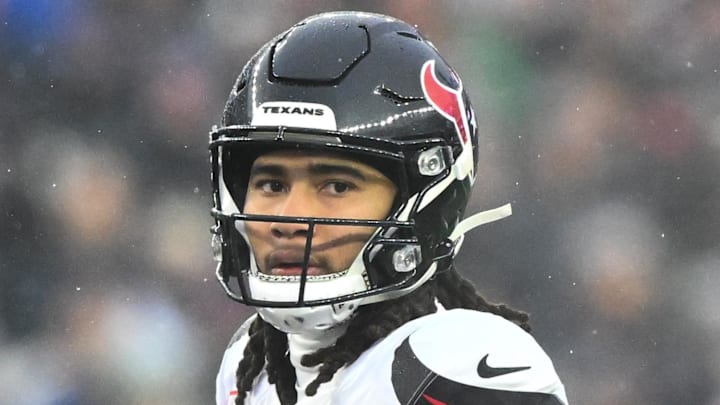
The NFL world is still having its fill of entertainment at Houston Texans quarterback C.J. Stroud’s expense a full 10-plus days after the conclusion of Super Bowl LX.
It’s been over a full month since Stroud’s fumbling frenzy against the Pittsburgh Steelers and his pick-party against the New England Patriots, yet fans and media (local and national) are scrutinizing him as though it happened yesterday.
To be fair, it was one of the worst stretches of play in professional sports history, and arguably the worst two-game stretch for a quarterback in NFL history. His performances are seen by many as the sole reason for why the 2025 Texans, specifically their historic defense, didn’t advance to the AFC Championship game and then to Santa Clara for the Super Bowl (both would’ve been first’s in franchise history).
Therein lies the issue, though. The continued negative discourse surrounding the 24 year old former Buckeye and Offensive Rookie of the Year is helping to reveal an even larger problem within the NFL conversational climate: The quarterback position is valued way too highly, and it's hurting the overall perception of the on-field product.
Revisionist history has led to overvaluing the quarterback position
For what seems like decades now, national media pundits have continuously proclaimed that quarterback in the NFL is the “hardest position in all of professional sports”. It’s seen as the pinnacle of all NFL dialogue and the complete summation of what teams should strive to build their franchises around on a year-round basis.
These sentiments are held by those who’ve watched legendary names like Dan Marino, John Elway, Peyton Manning, Drew Brees, Joe Montana, Patrick Mahomes and of course, Tom Brady.
By comparison, they now look to quarterbacks like Josh Allen, Lamar Jackson, Joe Burrow, Caleb Williams, Jared Goff and even Stroud to pick up the proverbial “baton” and race their teams to multiple Super Bowl championships. That is, if they’re cut out for the task.
The problem with that is, there is much “revisionist history” that has come with propping up the aforementioned giants of the game, and it needs to be addressed.
Wins are not a quarterback statistic
For starters, many of yesterday’s legends never actually won the game’s biggest prize. Names like Marino, Matt Ryan, Phillip Rivers, Donovan McNabb, Jim Kelly and Warren Moon ended their storied careers without ever hoisting a Lombardi trophy. Yet, history looks back fondly on their accomplishments and overall contributions to the game of football.
Additionally, guys like Eli Manning, Aaron Rodgers, Drew Brees, and Brett Favre only walked away with one title. Still, they are regarded as some of the best of all time.
Then, and no disrespect intended, players like Trent Dilfer, Nick Foles, Jeff Hostetler and Jim McMahon are cemented in NFL history with Super Bowl wins. In this case, the words of First Things First Analyst Nick Wright holds true, “wins are not a QB stat.”
Defenses have always reigned supreme in the biggest moments
Which leads to the next point, which is that the quarterback is oftentimes one of the least responsible for why a team wins the big game at the end of the season.
Defenses like the storied 1985 Bears, 2000 Ravens, “No Fly Zone” Broncos, “Legion of Boom” Seahawks and now the “Dark Side” Seahawks have paved the way for many a title to be secured, not necessarily their respective signal callers playing under center.
It was their defensive onslaughts that ravaged opposing offenses and flipped their Super Bowl contests in their favor, not their offenses.
There are other vital pieces to the Super Bowl puzzle
To continue, this commentary would be insufficient without the mention of kickers and how they’ve arguably won more championships for their teams than their passers have.
Guys like Adam Vinatieri, Stephen Gostkowski, Harrison Butker and now Jason Myers have etched their names in NFL lore by their consistency and clutchness, leading to multiple rings that wouldn’t have been won without them.
Time would fail us to go on in mentioning the tight end position, offensive line, coaching staffs and ownership groups that are necessary for authentic team success and longevity.
An imperfect process will always lead to imperfect results
In closing, ignoring facts like this has created an unhealthy expectation of modern passers and their team impact. It results in an endless pursuit of the “perfect quarterback," causing franchises to cut ties with talent prematurely to then start the search all over again. In doing so, certain teams have been perpetually bad and will continue to be so until their thought process towards team building changes.
There’s a reason why Michael Jordan never won a championship without Scottie Pippen, why Kobe Bryant never won without a Shaquille O’Neal or Pau Gasol and why LeBron James never won until he got with Dwyane Wade and Chris Bosh.
Winning is hard, and this is especially true when trying to carry the load by oneself.
Romanticizing the quarterback position into oblivion is how we as a sports society have arrived at this place of knee jerk reaction and “hot take” analysis.
Until our collective mentality towards quarterback value and development improves, young players like Bryce Young, Jayden Daniels, Bo Nix, Drake Maye and Stroud will continue to face a torrent of hyperbolic rhetoric and regurgitated criticism.
Maybe it’s not the quarterbacks who are the problem most days. Maybe it’s the evaluators and analysts who expect one player to do the job of 53.
 Add us as a preferred source on Google