

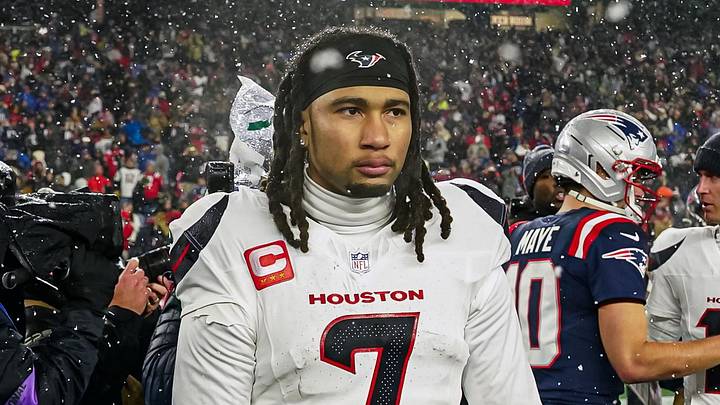
I know what you might be thinking. "Why is this Houston Texans sports writer guy spouting off another opinion piece on C.J. Stroud's failures last year? Enough already." I get it. It's a talking point that's been discussed ad nauseum since the final whistle of the Texans' 28-16 loss in Foxborough back in January.
However, today I decided to revisit the crime scene of the 2025 AFC Playoffs to look for evidence that we might've missed the first time. The goal of this being to re-examine what happened across his two disastrous games against the Pittsburgh Steelers and Patriots respectively, and to re-evaluate whether or not the negative public commentary has been out of bounds now that more time has passed.
As a preface, this is is no way to fully exonerate Stroud, as his two-game stat line in the 2025 postseason is arguably the worst in NFL history for a quarterback regardless of any analysis I could give independent of that. This, my Texans readers, will be a breakdown of each individual turnover from the now-infamous run, in hopes that maybe the contextual implications of each combined will lead to a more encouraging sentiment of Stroud heading into his fourth year in 2026.
We'll be going in order, starting with his mishaps against the Steelers, leading into the crescendo of his implosion against the Patriots a week later.
2025 AFC Wildcard Game: Texans vs. Steelers (3 TO's)
Turnover #1: Forced Fumble (caused by Steelers LB Jack Sawyer)
- Down and distance: 1st & 10 at PIT 40
- Time on clock: 2:10 left - 1st quarter
- Previous play: 16-yard pass from C.J. Stroud to wide receiver Xavier Hutchinson
- Offensive Play call: Flea Flicker with running back Woody Marks
- What really happened?: Texans right tackle Blake Fisher was beat on the play by Steelers linebacker Jack Sawyer, leading to Sawyer knocking the football out of Stroud's hands and into the grasp of Steelers defensive end Yahya Black.
- What could Stroud have done? Take a sack, rush towards the sidelines to preserve the drive or towards the field of play for a yard or two
- Who/What I blame?: Playcalling, great play by defender(s)
My analysis: The call for a flea-flicker at that time felt very unnecessary on the part of offensive coordinator Nick Caley. The offense was moving the ball well enough down the field to where a "schock" play really wouldn't have done anything except for allowing the Steelers' opportunistic defense to try and make a play. Which, they did. I blame the play-calling on this one, as it undermined the flow of the drive and put Stroud and the offense in a compromising position.
Turnover #2: Forced Fumble (caused by Steelers DT Keeanu Benton)
- Down and distance: 2nd & 6 at HOU 23
- Time on clock: 6:20 left - 2nd quarter
- Previous play: 4-yard run by running back Woody Marks
- Offensive Play call: Pass play
- What really happened?: Stroud dropped the football on the snap, causing him to rush himself in efforts to pick it up and get back into the play. He then ran himself into the pressure-packed interior area of the offensive line, getting sacked by Steelers defensive tackle Keeanu Benton in the process.
- What could Stroud have done? Take a step back to give himself more space behind the line to either throw the ball away or just take a sack out of precaution.
- Who/What I blame?: C.J. Stroud
My analysis: This was the first turnover of the game that I would actually attribute to Stroud. Although the pocket wasn't the cleanest, it still held up long enough to make up for Stroud bobbling the snap and hurrying to pick it up. He then had a moment to survey the play and live to play for another down on the drive. Instead, he seemingly panicked and ran himself into the crowd of bodies at the line of scrimmage, and thus Benton popped the ball out for defensive end T.J. Watt to recover. Poor decision by Stroud, didn't mitigate damage of the dropped snap.
Turnover #3: Interception in the red zone (caught by Steelers CB Brandin Echols)
- Down and distance: 3rd & 4 at PIT 14
- Time on clock: 10:32 left - 3rd quarter
- Previous play: 2-yard pass from C.J. Stroud to tight end Dalton Schultz
- Offensive Play call: Pass play
- What really happened?: From a relatively clean enough pocket, Stroud began to hop and bounce in between bodies to look for a cleaner opportunity to pass. He then went off-platform and hurled an ill-advised pass towards the goal line intended for Texans wide receiver Xavier Hutchinson. Instead, it flew into the waiting arms of Steelers cornerback Brandin Echols.
- What could Stroud have done? Stroud could've opted to use his legs to either pick up yardage for a closer field goal attempt, or just to get out of bounds and preserve the field goal try. He also could've just thrown the ball away.
- Who/What I blame?: C.J. Stroud
My analysis: This one was arguably his most egregious of the game. Houston was essentially guaranteed at least three points if Stroud protected the football at all. Instead, they left with zero points and a head scratching turnover by a player who should know better. This was an example of poor situational IQ by way of trying to do too much.
2025 AFC Divisional Game: Texans vs. Patriots (4 TO's)
Turnover #1: Interception (caught by Patriots CB Carlton Davis III)
- Down and distance: 1st & 10 at NE 36
- Time on clock: 1:44 left - 1st quarter
- Previous play: 2-yard run by running back Nick Chubb
- Offensive Play call: Pass play
- What really happened?: After the snap, Stroud lobbed a pass deep downfield along the left sideline intended for Texans wide receiver Christian Kirk. Either that, or Stroud meant to float the pass just far enough to where it would harmlessly fall out of bounds if no one caught it. Unfortunately, none of those two outcomes happened, and Patriots cornerback Carlton Davis III made a great break on the ball to grab a highlight interception by getting one knee down in bounds before rolling out of play.
- What could Stroud have done? Stroud could've committed to throwing the pass out of bounds instead of trying a high-difficulty pass play with defenders rushing him in the pocket. Or, take a sack out of precaution.
- Who/What I blame?: Great play by the defender, C.J. Stroud only slightly
My analysis: On this one, I give more credit to Davis for making a heck of a play to get that knee down before rolling out of bounds. If not, it would've been second down and a dodged bullet for Stroud and co. on offense. Stroud threw the pick, but Davis had to make a great play for it to matter.
Turnover #2: Interception (caught by Patriots CB Marcus Jones)
- Down and distance: 1st & 10 at HOU 25
- Time on clock: 10:31 left - 2nd quarter
- Previous play: 10-yard touchdown pass from C.J. Stroud to Texans wide receiver Christian Kirk
- Offensive Play call: Pass play
- What really happened?: After the snap, Texans tight end Harrison Bryant tripped and fell during the play, presumably taking him away as either a blocker or an immediate receiving option for Stroud. With him down, Patriots linebacker K'Lavon Chaisson came rushing through the gap and into Stroud's chestplate. However, instead of taking the sack, Stroud backpedaled into a highly ill advised pass attempt that floated into the air and into the arms of Patriots cornerback Marcus Jones, who then promptly took the interception 26 yards for the score.
- What could Stroud have done? Take sack
- Who/What I blame?: C.J. Stroud, Chaisson's rush, Bryants's trip
My analysis: Similar to the interception in the Steelers game the week before, this play against the Patriots was arguably the most egregious of the day. In fact, I'd argue this was his second-most egregious turnover behind the aforementioned Steelers pick, due to at least having pressure in his face this time. This was just poor damage control by Stroud on what appeared to be a broken play because of Bryant tripping at the line of scrimmage. Also, credit to Chaisson for creating havoc with his bullrush through the open line in the line of scrimmage. This immediately flipped the game by in New England's favor, giving them a lead (14-10 at the time) that they would never relinquish.
Turnover #3: Interception (caught by Patriots S Craig Woodson)
- Down and distance: 2nd & 11 at HOU 36
- Time on clock: 8:37 left - 2nd quarter
- Previous play: -1 yard tackle for loss of running back Woody Marks
- Offensive Play call: Pass play
- What really happened?: In this case, Stroud threw a pass over the middle to Texans wide receiver Xavier Hutchinson. Hutchinson tipped the pass into the air, which was then grabbed by Patriots safety Craig Woodson.
- What could Stroud have done? Besides lower his pass a bit, there's not much he could've done.
- Who/What I blame?: Hutchinson's drop, the height of Stroud's pass (only slightly)
My analysis: Hutchinson himself would tell you that he should've caught this pass. Even if Stroud's throw was a bit high, an NFL receiver makes his bones by catching both easy and difficult pass attempts. This one just got away from Hutchinson, and unfortunately ended up as another interception on the stat sheet for Stroud.
Turnover #4: Interception (caught by Patriots CB Carlton Davis III)
- Down and distance: 1st & 10 at NE 49
- Time on clock: 2:00 left - 2nd quarter
- Previous play: 16-yard pass by C.J. Stroud to Texans wide receiver Jayden Higgins
- Offensive Play call: Pass play
- What really happened?: Stroud just missed his receiver (Xavier Hutchinson) by throwing behind him, thus allowing Patriots cornerback Carlton Davis III make a play on the ball and come away with his second interception of the game.
- What could Stroud have done? Lead Hutchinson with the pass, or just throw the ball out of bounds instead of forcing the play.
- Who/What I blame?: Stroud's accuracy
My analysis: At this point in the game, this turnover just felt like evidence of Stroud being mentally defeated. When he wasn't able to make routine throws anymore, this is when I felt like the game was almost officially out of reach. A simple out route became his fourth interception of the first half.
The Verdict: Less is more for Stroud
Upon further review of these two games, the details reveal a a consistent theme for the now-fourth year signal caller. By Stroud's own admission, he has a tendency to over compensate in high-leverage moments. At times, it can lead to magnificent chunk plays that happen because of his innovative skill and aggressiveness downfield. At other times, it leads to broken plays compounding into worse plays because he doesn't know how to live for the next down.
In the two aforementioned playoff games, Stroud was faced with multiple moments where circumstances weren't ideal. Teammates injured, questionable playcalls, uneven offensive line play, etc. However, Stroud still had a responsibility to help the team overcome the trials. Instead, he floundered due to him trying to put on the proverbial "Superman's cape" to try and save the day for his teammates.
Simply put, the more Stroud understands when to give up on a play, the better the offense will be for it. For him, he has to learn that winning the war is far more important than trying to win every single battle. Not every single thing was/will be his fault, but it's on him as an on-field leader to make the right decisions that minimize mistakes, not magnify them.
 Add us as a preferred source on Google