

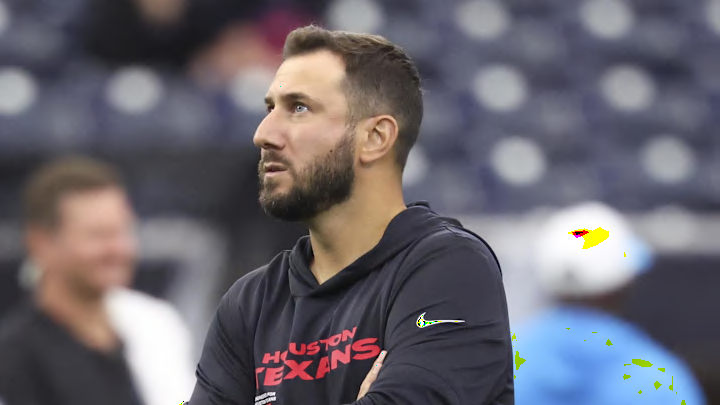
After the NFL Draft, even more pressure has been put on Houston’s offense to elevate to a higher level of performance heading into 2026. Specifically, quarterback C.J. Stroud is seen as having a scorching-hot spotlight aimed directly at him as he enters the fourth year of his career.
After a historic NFL Offensive Rookie of the Year-winning season that saw him throw for over 4,000 yards, 20-plus touchdowns and only five interceptions, audiences have watched as Stroud’s production has ebbed and flowed for the last two seasons.
This was of course punctuated by the worst two-game stretch for a quarterback in playoff history, as he was responsible for seven turnovers (five interceptions, two lost fumbles) across postseason matchups against the Pittsburgh Steelers and the eventual AFC-representing Super Bowl representees in the New England Patriots.
To be fair, he’s helped lead the franchise to back-to-back AFC South titles, three consecutive AFC Playoff berths and three-straight AFC Divisional Playoff rounds. Also to keep in mind, he did this while enduring the hiring, firing and more hiring of two rookie offensive coordinators in Bobby Slowik and now Nick Caley respectively. Additionally, he’s had to perform in spite of one of the most volatile offensive line units in the entire NFL. All things considered, Stroud has been set up to fail in almost every significant way on the offensive side of the football.
Yet, critics and skeptics point to the evaporation of his poise, decision-making, on-field leadership and temperament as evidence that he in fact has ‘regressed’, and that he is no longer of top-10 caliber.
However, former NFL wide receiver, current NFL Analyst and C.J. Stroud ‘confidant’ T.J. Houshmandzadeh came to Stroud’s defense on a recent episode of the SpeakEasy Podcast. In it, he gave behind-the-scenes insight on his thoughts on Stroud’s immediate response to the recent controversies, as well as an interesting nugget that could be a warning sign of issues that could still be bubbling beneath the surface involving Caley’s offensive infrastructure as a whole.
Texans still facing questions about OC Nick Caley’s scheme
Houshmandzadeh began his statement with a light assessment of his thoughts on how Stroud has processed his recent meltdowns.
“I believe it was a learning lesson for CJ. I talked to him at length, long time, a couple weeks ago. There’s a lot of things that go on behind the scenes that nobody ever hears about & knows about, I’ll leave those conversations private.
It was typical ‘coach’ speech in a sense, as Houshmandzadeh made sure to not reveal anything significant that could qualify as too personal or revealing. Then, he made a veiled statement that paints a picture of uncertainty regarding the offensive game planning of Stroud’s coordinator in Caley.
“For CJ it’s can him & his OC mesh. I don’t think people really understand how much play calling matters in the NFL. You watch that playoff game, as a coach, when you see he’s not having a good game, why am I steady dropping back throwing the ball? We can’t run any screens, a slant, easy stuff. Let me get him some easy completions to see if we can get rolling. That’s what Sean Payton would do.”
These words presumably will strike a nerve amongst the fanbase and local media, as angst has existed for months over the perceived schematic disadvantages that Houston entered various contests with due to the inexperience of Caley. Though Houshmandzadeh didn’t directly come out and say it, reading between the lines would lead one to believe that Caley’s scheme and situational playcalling will be just as much under scrutiny as Stroud’s performances will be going forward.
Caley will be under a microscope in 2026
Being brought over from the Los Angeles Rams, Caley was tabbed to fix an offense that fell off of a cliff under the guidance of his predecessor in Slowik. Ineffective adjustments, rigid infrastructure and scoring droughts defined the Texans in 2024, and it led to Slowik’s unceremonious ouster after their Divisional matchup against the Kansas City Chiefs.
In 2025, Houston’s offense sputtered throughout the year, which was not a good sign for those hoping for a dramatic turnaround in Caley’s first year. For reference, they didn’t score a touchdown until week two (vs. Tampa Bay Buccaneers), nor a red zone touchdown until week four (vs. Tennessee Titans). Then, Houston produced only one individual 100-yard rushing performance for the entire regular season (Jawhar Jordan vs. Arizona Cardinals). Even worse, the Texans ended the season as one of the four worst red zone offenses in the NFL.
Simply put, there’s more than enough evidence to support the theory that Caley is more responsible for Stroud’s struggles than what’s been openly projected by the team.
Stroud has to wear his playoff disaster, but Caley shouldn’t be too far behind as one needing to prove himself in 2026. If not, Houston could potentially move on from Caley with eyes set on who would hopefully be a more effective offensive table-setter.
 Add us as a preferred source on Google