

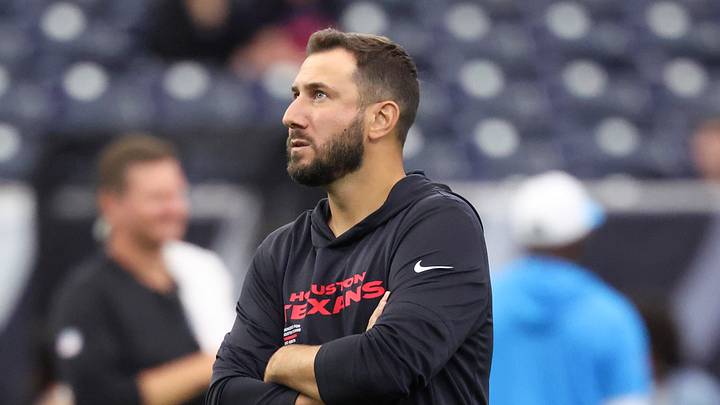
Houston Texans offensive coordinator Nick Caley has seen his reputation under fire constantly since his hire last season, specifically due to the perception that his offenses lack any real punch or creativity in high-pressure moments. One example of why the skepticism exists can be found in an evaluation of Houston's dismal production in the short-yardage production department.
According to NFL Next Gen Stats, Caley's unit has displayed problematic tendencies already through only two games of NFL play in situations where the offense has to perform in condensed areas of 0-2 yards (hence the term, short-yardage). As of today, across 20 total plays in said situations (third-most), Houston's offense has rankings of:
Pass/Run balance:
8 pass attempts (3rd-most), 12 rush attempts (T-2nd most)
Passing:
25.0 Passing YPG (2nd-highest)
6.3 Passing YPP (8th-highest)
-0.46 EPA/Pass (23rd)
37.5% QBP (12th-highest)
Rushing:
8.5 Rushing YPG (17th)
1.4 Rushing YPP (T-25th)
-0.25 EPA/Rush (24th)
Total yards/Scoring:
33.5 YPG (4th-highest)
18.5 PPG (21st)
3.4 YPP (13th)
1 TD (T-12th)
-0.33 EPA (27th)
While the causes of such results could vary based on offensive line combination, injuries, personnel packages and opponents faced, the reality is that Caley's offense is facing the prospect of yet another season of being ranked near the bottom of the league as a "clutch-time" offense (a term I made up). Regardless, there are several takeaways from this data that will help contextualize what is happening on Sunday afternoons.
Analyzing the short-yardage offense of the Houston Texans
The Houston Texans are in short-yardage situations way too much for their liking
For myself personally, I believe that Houston being the third-ranked offense in volume of short-yardage situations played in could mean one of two things: Either the Texans are great on moving the football on first and/or second downs, or they're horrible at converting chunk-play opportunities (which is much more likely the case). If it's the latter, then it would explain why Caley and co. face as many condensed areas as they do.
If they could find a way to move the football more effectively on first and second down, then they wouldn't have to keep manufacturing conversions under duress.
If Houston wants to convert, they must put the football in C.J. Stroud's hands
According to the data, quarterback C.J. Stroud has the second-highest mark in total passing yards per game in the aforementioned short-yardage situations. He's also averaging over six yards per passing play in these moments, which means that he's normally money when it comes to moving the chains for the offense with his arm. If the Texans want to have the best chance of advancing down the field when they're in these tight squeezes, Stroud currently gives them the clearest path to doing so.
Houston is one of the worst rushing teams in football in short-yardage situations
The night-and-day difference between the passing success and rushing success while facing the same circumstance is astonishing. While conventional wisdom would say that running the football in these moments is the most sound decision to make, the truth is Houston has had chronic issues with taking advantage of what normally should be seen as a favorable opportunity for an offense.
The fact that they sport a 1.4 rushing yards per play mark in these moments is a dismal sign that teams have no problem with stonewalling Houston's "new-look" offensive line and rushing attack, which completely flies in the face of all the offseason preparation that general manager Nick Caserio and co. sold the fan base on. The more things change in Houston, the more things have stayed the same.
 Add us as a preferred source on Google