

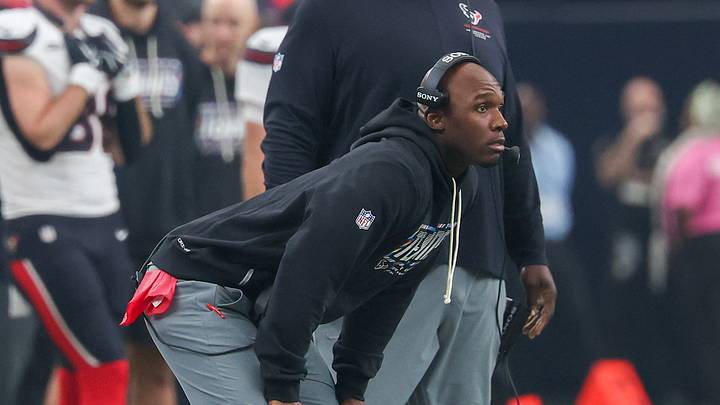
By reassuming defensive play calling duties from defensive coordinator Matt Burke, Houston Texans head coach DeMeco Ryans took the first crucial step in course-correcting a unit that's fallen on its collective face to open the 2026 regular season.
There have been occasional flashes of the same brilliant domination from 2025. However, catastrophic failures in the secondary, and ineffective pass rush (outside of defensive ends Will Anderson Jr. and Danielle Hunter) and a lack of consistent turnover production has hamstrung the team and cost Houston three highly-winnable contests across the first month of the campaign (Buffalo Bills, Indianapolis Colts, Dallas Cowboys).
WIth Ryans now back behind the wheel, fans and local media are excited to hopefully see some immediate returns in the form of a defensive renaissance this Sunday against the Tennessee Titans and their quarterback Cam Ward. With that in mind, here are three corrections of the defense that I'll be closely monitoring for in Ryans' return to the defensive play sheet.
Three things the Houston Texans defense must correct in DeMeco Ryans' return as defensive coordinator
Man-coverage vs. Zone-coverage balance
As of today, Houston has the sixth-highest rate of zone-coverage ran at 84.3% (according to Sharp Football Analysis). As one of the many results of such a high volume of zone play calling, opposing teams have been able to pick the Texans' secondary apart piece by piece. Against Houston, teams are opting to throw at the seventh-highest rate in the NFL at 60.8%, as well as generating the fifth-highest amount of total passing yards against at 1,040.
This wouldn't been unheard of last season, but my working theory is that there are at least 2-3 specific defensive backs whom the Texans might be trying to finesse through games by not asking them to play too much man-coverage (Kamari Lassiter, Jalen Pitre, Reed Blankenship). The problem with that has been that elite passing teams (Bills, Bengals, Cowboys) have been smart enough to either hunt the aforementioned players in coverage, or to just abuse the coverages by constantly just taking advantage of the 5-10 yards of cushion that Houston's defensive backs have allowed at the line of scrimmage.
I expect to see some level of balancing out happening this Sunday against Tennesse.
Secondary personnel changes (if necessary)
Speaking of struggles in the secondary, the Texans will actually be getting back reinforcements in the form of ninth-year veteran safety M.J. Stewart, as he returns from a torn quad suffered in November of last season. The reason for his listing here is that his previous four years of experience in Houston's defense (2022-2025) would be a massive boost for a unit that's desperate for consistency.
Additionally, I'm thinking there's a chance that he and rookie Kamari Ramsey could even cut into Blankenship's rep-count in week five, as the former Philadelphia Eagle currently leads the team in passer rating allowed (125.0), the most touchdowns allowed (2), has the second-highest mark in yards allowed (220) and the second-most receptions given up (16).
Even though I'm not an NFL general manager, I can confidently say a front office doesn't foot a three-year, $24.75 million contract for that type of performance (while also being the third-highest paid defensive back on the team behind Derek Stingley Jr. and Jalen Pitre). With that in mind, more ineffective play by Blankenship in this Titans affair might lead to a quick hook if Ryans deems a swap necessary.
Better red zone defense
Even though the Texans have the ninth-lowest amount of yards per game allowed in the red zone (23.0), there's still some troubling trends to be noticed once teams enter the deepest parts of Houston territory on Sundays.
In points per game allowed in the red zone, Houston is tied with the Carolina Panthers at sixth-worst (27th) in the league at 27.3. In the same down-and-distance scenario, the Texans are also 20th in passing yards per game at 16.5 and fourth-worst (29th) in EPA/pass at +0.23. They've done all this while giving up seven touchdowns in the area.
If Houston really wants to get things back in gear defensively, tightening up in the red zone has to be one of their top priorities (or, how about just not allowing teams to get there in the first place?)
 Add us as a preferred source on Google