

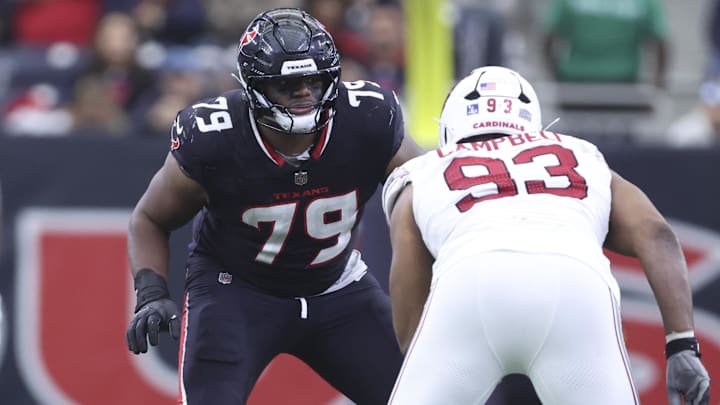
Last year at this time, after having given up the third-most sacks in the NFL in the 2024 season, it was no secret that objective number one for the Houston Texans heading into the offseason had to be making meaningful changes to what was by any measure one of the league's worst offensive lines.
Clearly, the Texans understood that assignment, replacing four of the previous season's starters with new faces, making a bet that a fresh start, even without a blue chipper coming in, would be better for the state of the team than running things back and banking on continuity providing a boost forward.
In the end, this bet did indeed pay off. After giving up 54 sacks in 2024, the Texans surrendered just 31 sacks in 2025, the second-biggest improvement of any team in the NFL behind only the Chicago Bears, who went from giving up the most sacks in the NFL (68) in 2024 to the second-fewest (24) in 2025.
And yet, as the NFL offseason is just one month away, Houston finds itself in the very same position they were in last year. There's a clear need for better offensive line play, even though there were strides made from 2024 to 2025.
This is at least in part the case because for the most part, the rest of the Texans roster is so well set up for the future. While adding depth pieces to its defense, and surrounding CJ Stroud with a couple of more playmakers is certainly on the Texans agenda, item number one has to be ensuring that the offensive line doesn't plateau, or even worse, regress in 2026. Frankly, Houston's offense can't afford it.
Even though the Texans gave up 23 fewer sacks in 2025 than they did in 2024, this is still a unit that is considered below average by both Pro Football Focus (finishing 27th in year-end rankings) and Pro Football Network (24th), not only due to the fact that there is still room for improvement in pass protection, but more specifically because as a run blocking unit, this group was well below-average.
The Texans were one of just five teams that rushed for fewer than 4 yards per carry during the 2025 season, and on 3rd/4th and short situations, Houston's offensive line often failed to get the push necessary to move the chains with the degree of consistency you'd hope for in those spots.
So with all of that said, the question that the Houston Texans need to answer is, 'How for the second straight offseason do we make sure our offensive line is better than it was last year?'
The answer to that question can be provided in three simple steps:
1. Re-Sign Ed Ingram - Keeping Ingram could prove to be costly, but this is not the time for the Texans to once again decide that continuity is overrated. The fact that Ingram played at a near Pro Bowl level A) while on a rookie deal, and B) after being acquired for a 7th round pick, was a godsend for the Texans, but now's the time to keep Ingram in town, even if it requires paying him somewhere in the neighborhood of $10 million annually.
2. Use the 28th and/or 39th overall pick to select the closest thing possible to a blue-chipper along the interior of the offensive line - As we dive deeper into Draft coverage here at Toro Times over the next two months, we'll explore the various players -- both centers and guards -- that the Texans should be eyeing with this pick, but assuming Vega Ioane (Penn State), Logan Jones (Iowa), Chase Bisontis (Texas A&M) or Emmanuel Pregnon (Oregon) are available when Houston is on the clock, the choice should be clear.
3. Light a fire under the a** of Aireontae Ersery - Your feelings about Aireontae Ersery's rookie season are likely dependent on whether you are generally a glass half full or glass half empty sort of person. On one hand (the hand holding a glass that is half full), for a rookie 2nd round pick to come into a situation where he's the day one starter at left tackle for a team with Super Bowl ambitions, Ersery played reasonably well during his rookie season.
On the other hand (the hand holding a glass that is half empty), Ersery didn't exactly flash Pro Bowl potential at any point during his first NFL season. Granted, it's a small sample size that we're dealing with here, but Ersery's trajectory isn't currently that of a guy who you'll want to reward with a big second contract after his rookie deal runs out, and for the Texans, that's a huge problem.
So although Phase Two of the offensive line rebuild in Houston is much different than Phase One, the Texans need to attack this offseason with the same sort of desperation as they did last year.
 Add us as a preferred source on Google