

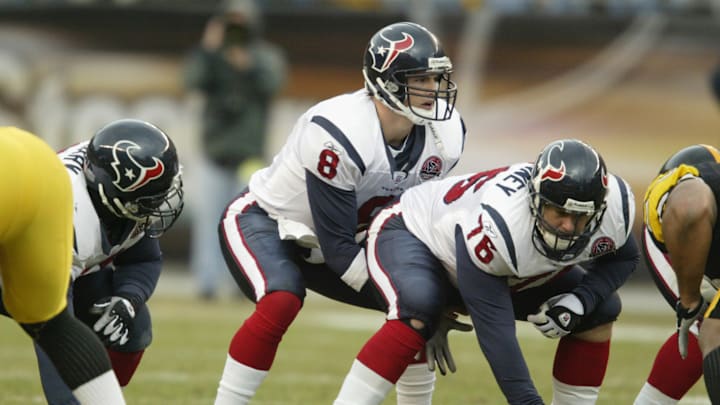
The Houston Texans are set to make their ninth all-time NFL playoff appearance after securing the No. 5 seed with Sunday's win over the Indianapolis Colts. With the AFC South going to the Jacksonsville Jaguars, it marks Houston's first ever playoff appearance as a Wild Card team, rather than as the AFC South champion.
As a result, they are set to travel to western Pennsylvania to take on the No. 4 seed Pittsburgh Steelers, who won the AFC North with a 10-7 record thanks to Baltimore Ravens rookie kicker Tyler Loop's missed 44-yard field goal as time expired on Sunday Night Football.
The Texans, who finished the regular season at 12-5, do not have a super lengthy history with the Steelers, having only been in the NFL since 2002. They have only matched up every three years since then, which is as little as two AFC teams can possibly face one another. The two teams haven't played since October 2023, when the Texans beat them 30-6 at home.
The Texans are 3-5 all-time against the Steelers, including 1-3 at Heinz Field (now Acrisure Stadium) in Pittsburgh. Their lone road win came all the way back in the franchise's inaugural season, and it was a bizarre win, to say the least.
Texans own NFL's most improbable win ever over Steelers
Reverse Post-Game Win Expectancy (PGWE) measures how often a team with the given game stats – so pretty much everything important, other than the final score – would be expected to win said game.
This past Sunday's game between the Cleveland Browns and the Cincinnati Bengals, won 20-18 by Cleveland, ranked No. 6 since 1978 at just 1.1% for the Browns.
Cleveland's 20-18 win over the Bengals yesterday was the No. 6 biggest "Reverse PGWE" win since 1978.
— Aaron Schatz 🏈 (@ASchatzNFL) January 5, 2026
Post-Game Win Expectancy is a metric that looks at how often we would expect a team to win given the underlying game stats.
Browns should win 1.1% of the time. pic.twitter.com/fyTGT85j4N
But No. 1 on the list was particularly noteworthy, given this coming Monday night's Wild Card matchup.
The all-time record for reverse PGWE goes to the Houston Texans in their December 2002 win over the Pittsburgh Steelers. They won that game by a score of 24-6, but statistically speaking, they should have only won that game 0.4% (four times out of 1,000) of the time.
Quite frankly, looking at the stats, even that percentage is probably beyond generous.
Houston-Pittsburgh 2002 one of the all-time greatest nfl box scores https://t.co/YLNSG33SoT pic.twitter.com/VAIWLGLJpg
— Stuckey (@Stuckey2) January 5, 2026
Houston tallied just three first downs, including one from a penalty, compared to Pittsburgh's 24. They totaled just 47 yards on 40 plays; Pittsburgh totaled 422 on 95, giving them roughly four times as many yards per play as their opponents, and with 55 extra plays to boot.
Yet Houston won by three possessions.
Quarterback David Carr completed just three out of his 10 passes, all to tight end Billy Miller, for 33 yards. He was sacked four times for 23 yards, giving the team just 10 net passing yards. James Allen led the team with 13 carries for 19 yards; Jonathan Wells had 10 for 12. Carr himself ran it three times for six yards.
That's it.
Yet Steelers quarterback Tommy Maddox was 30-for-57 with 325 yards. Pittsburgh tallied 128 yards on 31 carries. So what on earth went wrong?
Turnovers, turnovers, and more turnovers.
The Texans' first drive of the game was a seven-play drive that went for a total of 19 yards. It was their longest drive of the game. It didn't matter.
Cornerback Kenny Wright returned a Maddox fumble 40 yards for a touchdown in the first quarter to give Houston a 7-0 lead. Cornerback Aaron Glenn returned a Maddox interception 70 yards for a touchdown later in the quarter to make it 14-0.
In the fourth quarter, with the Texans up 14-6, linebacker Troy Evans recovered an Antwaan Randel El fumble. After the ensuing four-play, negative-five-yard drive, Kris Brown hit a 43-yard field goal to extend the lead to 17-6.
On the ensuing drive, Glenn struck again, this time taking a Maddox interception 65 yards to the end zone to give him roughly three times as many interception yards on two plays as his team had offensive yards throughout the entire game.
Randel El actually fumbled twice in that game, with the first coming in the second quarter with the Texans up 14-0. But the recovery by safety Jason Simmons only led to a punt after a three-play, seven-yard drive.
Houston punter Chad Stanley finished the game with 10 punts for 421 yards, one yard shy of Pittsburgh's total offensive yardage that day.
The Texans also turned the ball over once, with cornerback Hank Poteat recovering a Jabar Gaffney fumble in the fourth quarter, but it led to a turnover on downs for Pittsburgh. Carr even fumbled twice, but he recovered both of his fumbles.
Additionally, the Texans benefitted from six sacks of Maddox, including two from linebacker Jamie Sharper, 1.5 from both linebacker Jeff Posey and defensive end Gary Walker, and one from linebacker Kailee Wong.
At the end of the day, a win is a win, and if there is any game that epitomizes that cliche, this is it. And when it comes to a January playoff game, I'm not sure that anybody really cares whether or not it's pretty.
 Add us as a preferred source on Google